


Why Nonviolent Communication is the Future of Cabin Safety

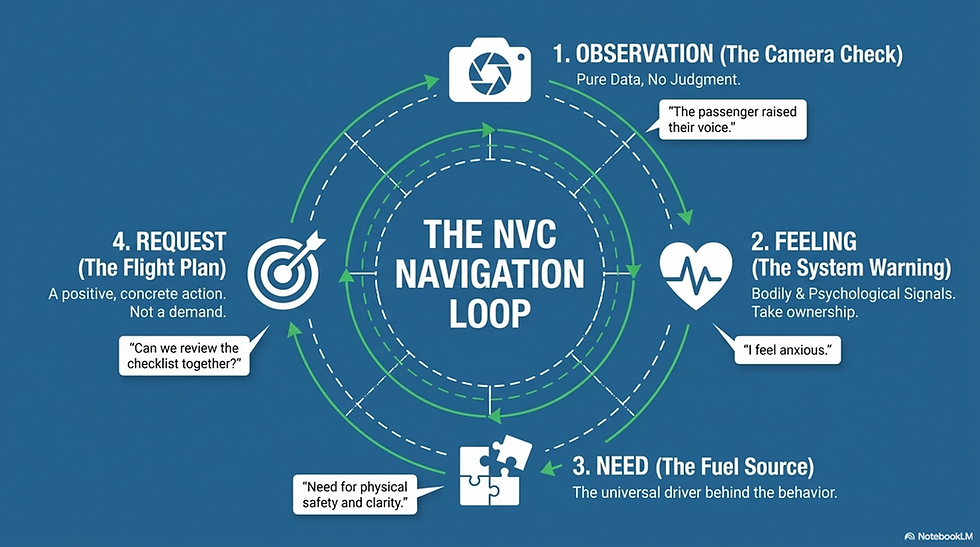
In the high-stakes world of civil aviation, cabin crews are not merely hospitality providers; they are the primary guarantors of flight safety and security. Operating in confined spaces while managing unexpected emergencies, time zone changes, and diverse passenger groups creates immense and multifaceted stress factors. To navigate this complex environment, the industry has long relied on Crew Resource Management (CRM). However, a new paradigm is emerging to deepen these protocols: Nonviolent Communication (NVC).
Dismantling the Authority Gradient
Historically, aviation has suffered from a strict hierarchical structure, and the resulting "authority gradient" between captains and crew has been the root cause of many aviation disasters. NVC directly addresses this by promoting a "Just Culture" where crew members can honestly report systemic flaws and personal errors without the fear of moralistic judgment or punishment.
By shifting from a "power-over" mentality—which relies on fear, shame, and obedience—to a "power-with" mindset, NVC empowers cabin crews. This ensures that every crew member can voice critical safety observations directly to the flight deck without the fear of being judged, effectively transforming standard Threat and Error Management (TEM) protocols.
The OFNR Framework in the Cabin
In dynamic cabin environments, NVC provides a structured, four-step methodology known as OFNR: Observation, Feeling, Need, and Request.
Observation: Much like following Standard Operating Procedures (SOPs), crews are trained to observe situations neutrally. For example, instead of judging a passenger as "rude," a crew member objectively notes specific actions (e.g., "the passenger raised their voice"), which prevents triggering defensive reactions.
Feeling: Aviation culture often demands that emotions be suppressed in the name of professionalism, which can lead to chronic stress. NVC encourages crews to recognize and own their internal feelings, such as anxiety or fatigue, as a crucial step for maintaining psychological health.
Need: According to Rosenberg, aggressive behavior is simply a tragic expression of an unmet universal need. Understanding that an unruly passenger's anger might stem from an unmet need for comfort, respect, or security helps crews de-escalate situations effectively.
Request: Finally, crews formulate clear, actionable, and positive requests rather than strict demands, ensuring smooth operational flow and collaboration.

Managing Emotional Labor and Unruly Passengers
Cabin crews constantly perform "emotional labor" to maintain a welcoming atmosphere, regardless of how they truly feel. Relying on "surface acting"—faking a smile while internally feeling frustrated—leads to high cortisol levels, burnout, and emotional alienation. Conversely, NVC fosters "deep acting," allowing crews to genuinely empathize with a passenger's underlying needs through "need literacy," which naturally reduces emotional fatigue and builds self-empathy and resilience.
When dealing with the rising number of unruly passengers, this empathetic approach perfectly complements the aviation industry's LEAP model (Listen, Empathize, Ask, Paraphrase). It shifts the focus from using "punitive power" to shame or punish a passenger, toward using "protective power" strictly to ensure flight safety and prevent harm.
A Cultural Transformation
For this communication model to be truly effective, it cannot just be a cabin crew training module; it must become a corporate culture. Just as CEO Satya Nadella transformed Microsoft's competitive "jackal" language into a collaborative "giraffe" language, airline management must also adopt a non-blaming, need-focused language to foster true employee loyalty and psychological safety.
While technical skills keep an aircraft airborne, it is CRM and compassionate communication that keep the human element safe and united. As the industry evolves with digitized cockpits, integrating a conscious communication model like NVC ensures that human connection remains our strongest safety net at 35,000 feet.


Yorumlar